
Genetic Lottery: Why Two Labradoodles Can Be Completely Different

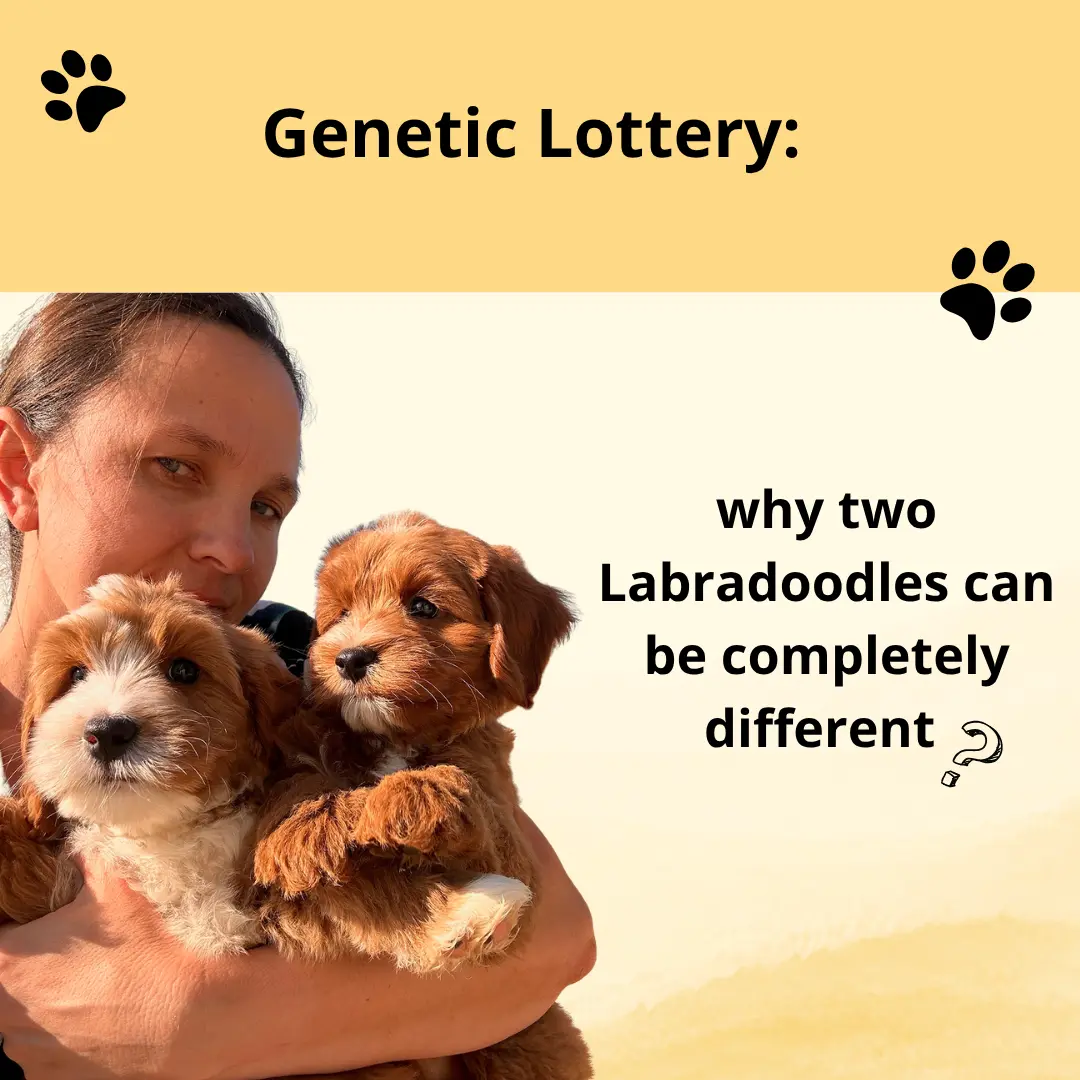
You could bring home two puppies from the same litter — and end up with two completely different dogs. One has a curly, low-shedding coat and a calm personality. The other sheds, acts like a bundle of energy, and looks more like a Labrador than a Poodle.
This isn’t bad luck — it’s the reality of Labradoodle genetic variability. If you’ve been researching Labradoodle temperament, coat types in Labradoodles, or expecting a predictable Labradoodle appearance, you need to understand one thing: this breed is not as uniform as it seems.
Labradoodle Genetics Explained: Why Variation Happens
The reason behind why Labradoodles are unpredictable lies in their origin. A Labradoodle is a cross between a Labrador Retriever and a Poodle — but genetics don’t split neatly 50/50 in practice.
In early generations (like F1 Labradoodles), puppies inherit random combinations of traits. One may take heavily after the Poodle, while another leans toward the Labrador side. This creates major differences in:
- Labradoodle coat types
- Shedding levels
- Energy and behavior
- Size and structure
This is what makes the Labradoodle genetic lottery so real — no two dogs are exactly alike.
Coat Types in Labradoodles: The Biggest Surprise for Owners
If there’s one area where Labradoodle traits variation becomes obvious, it’s the coat.
Most people search for hypoallergenic Labradoodles and expect a soft, curly, non-shedding coat. But in reality, there are three main coat types:
- Curly (Poodle-like): Low-shedding, often closest to allergy-friendly expectations
- Wavy/Fleece: A mix of both parents, popular and relatively manageable
- Straight (Labrador-like): Higher shedding, less suitable for allergy sufferers
Here’s the catch: two puppies from the same litter can fall into completely different categories. That means very different Labradoodle grooming requirements, from frequent professional grooming to simple brushing.
Hypoallergenic Labradoodles: Myth vs Reality
The term hypoallergenic Labradoodles is one of the biggest misconceptions around the breed.
While some Labradoodles shed very little, others shed almost as much as a Labrador. This depends entirely on which genes are expressed. There’s no guarantee — even within the same breeding line.
Also, “hypoallergenic” isn’t a scientific term. Allergies are triggered by proteins in dander and saliva, not just fur. So even a low-shedding dog may still cause reactions.
For anyone specifically searching for non-shedding Labradoodles, this unpredictability is a key risk to understand.
Labradoodle Temperament: Friendly… or Too Smart for Its Own Good?
Another area where Labradoodle temperament varies is personality.
Yes, both Labradors and Poodles are known for being intelligent and friendly — but that combination can produce very different results:
- Some Labradoodles are calm, affectionate, and easy to train
- Others are highly energetic, easily bored, and demanding
- Some develop stubborn or independent streaks
In fact, their intelligence can become a problem. Without enough mental stimulation, a Labradoodle may start destructive behaviors — chewing, digging, or constant barking.
So when people research Labradoodle personality traits, they often underestimate how intense and demanding these dogs can be.
Labradoodle Size Variation: Not Always What You Expect
Another overlooked factor is Labradoodle size variation. Many owners assume they know how big their dog will get — but that’s not always the case.
Depending on the Poodle parent (Toy, Miniature, or Standard), Labradoodles can range from about 10 kg to over 30 kg (22–65 lbs).
Even within one litter:
- One puppy may stay compact
- Another may grow significantly larger
This unpredictability makes planning harder — especially for people living in apartments or smaller spaces.
Can Breeding Reduce Labradoodle Genetic Variability?
Experienced breeders try to reduce Labradoodle traits variation by creating multi-generational dogs (F2, F3, or Australian Labradoodles). These lines tend to be more consistent in coat and temperament.
However, even with careful breeding, the Labradoodle genetic lottery never fully disappears. Variation is still part of the package.
If you’re researching how to choose a Labradoodle puppy, focus on:
- Parent coat types and shedding history
- Temperament of both parents
- Generation (F1 vs F1B vs multigen)
- Honest breeder transparency
These factors can reduce surprises — but not eliminate them.
What Future Owners Need to Understand
The idea of a “perfect” Labradoodle — non-shedding, calm, perfectly sized — is appealing. But in reality, Labradoodle genetic variability means you’re always working with probabilities, not guarantees.
This affects:
- Labradoodle grooming requirements
- Exercise needs
- Training difficulty
- Long-term maintenance
Instead of expecting a fixed outcome, successful owners adapt to the dog they actually get.
Final Thoughts: The Beauty of the Genetic Lottery
The Labradoodle genetic lottery can feel risky — but it’s also what makes each dog unique.
Two Labradoodles may look completely different, behave differently, and require different levels of care. But for many owners, that unpredictability becomes part of the charm.
If you go in informed — understanding why Labradoodles are unpredictable — you’re far more likely to enjoy the experience rather than be surprised by it.