Why Do Australian Labradoodle Puppies From the Same Litter Look So Different?
Why Australian Labradoodle littermates can have different colors, coats and sizes: a simple guide to genetics and what it means for choosing a puppy.
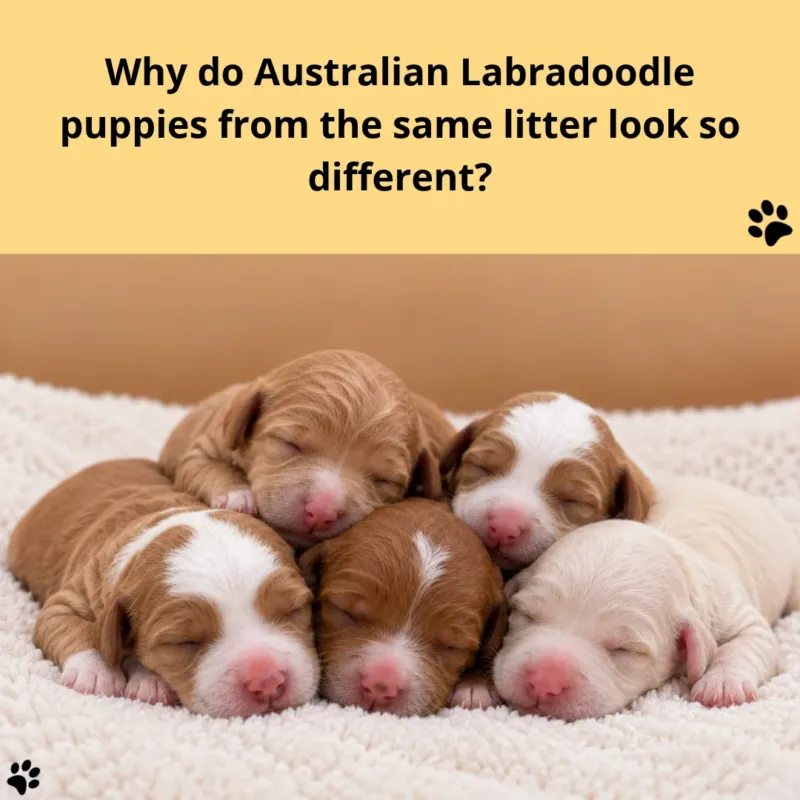
Have you ever seen a litter of Australian Labradoodle puppies and wondered how they could all have the same parents but look so different? One puppy might have a rich chocolate coat, another could be creamy white, and a third might have beautiful red fur with white markings. Even their curls, facial features, and sizes can vary. The reason behind these differences is Australian Labradoodle genetics. Understanding how puppies inherit their coat colors, textures, and physical characteristics helps explain why every puppy is unique.
How Do Australian Labradoodle Genetics Work?
Every Australian Labradoodle puppy inherits approximately half of its nuclear DNA from each parent. However, siblings receive different combinations of genetic variants, which influence their appearance.
Australian Labradoodles were developed through generations of selective breeding involving Poodles, Labrador Retrievers, and several other breeds, including English and American Cocker Spaniels.
Their genetic background contributes to the variety of characteristics seen in Australian Labradoodle puppies today.
Inherited traits can influence:
- Coat color and pigmentation
- Hair texture and curl patterns
- Adult size and body structure
- Facial features and ear shape
- White markings and coat patterns
Because each puppy inherits a unique genetic combination, even siblings from the same litter can look surprisingly different.
Why Do Australian Labradoodle Puppies Have Different Coat Colors?
One of the most noticeable differences between Labradoodle puppies from the same litter is their coat color.
Australian Labradoodle coat colors include cream, apricot, red, chocolate, black, and various shades in between.
Several genes influence coat pigmentation. Some determine whether a dog produces black or brown pigment, while others affect how these colors appear throughout the coat.
For example, two parents with similar coat colors may carry genetic variants that produce puppies with different shades.
A single litter might include darker puppies, lighter puppies, and puppies with distinctive white markings.
Interestingly, an Australian Labradoodle puppy’s coat color can change as it grows.
Some puppies gradually become lighter, while others maintain a relatively consistent color throughout adulthood.
This is why responsible breeders consider family genetics when discussing potential coat colors with future puppy owners.
Why Do Australian Labradoodle Coat Types Vary Within the Same Litter?
Coat texture is another reason Australian Labradoodle puppies can look different.
Some puppies develop soft, flowing waves, while others have more defined curls.
These differences are influenced by genes associated with hair texture and curl formation.
Australian Labradoodle coats are generally described using two main categories:
- Fleece coat: Typically soft and silky, with textures ranging from loose waves to defined curls.
- Wool coat: Usually denser, with tighter curls and a texture more similar to a Poodle’s coat.
Even puppies with the same general coat type may have noticeably different curl patterns.
However, their final adult coat may not be fully apparent during puppyhood.
Regular brushing and professional grooming are essential for maintaining a healthy Australian Labradoodle coat, regardless of its texture.
Can Australian Labradoodle Puppies From the Same Litter Grow to Different Sizes?
Yes! Siblings can reach different adult sizes, even when they share the same parents.
Adult size is influenced by multiple genes, and each puppy inherits a different combination.
One puppy might develop a smaller frame, while another grows taller or heavier.
Nutrition, health, and overall development also play important roles.
Experienced Australian Labradoodle breeders consider parental size, family history, and previous litters when estimating a puppy’s adult weight.
However, adult size predictions are estimates rather than guarantees.
Even puppies that look nearly identical at eight weeks old may develop noticeable size differences as adults.
Why Do Some Australian Labradoodle Puppies Have White Markings?
Have you noticed a Labradoodle puppy with white paws, a white chest, or a small white patch on its forehead?
These markings are another example of genetic variation.
White spotting patterns are influenced by genes that affect how pigment-producing cells are distributed during development.
Depending on the genetic combinations inherited from their parents, some puppies may develop noticeable white markings while their siblings have solid-colored coats.
These patterns can create beautiful combinations, including red and white, chocolate and white, or black and white.
Each puppy’s markings contribute to its individual appearance, making even closely related siblings easy to recognize.
Do Australian Labradoodle Puppies Change Appearance as They Grow?
Absolutely! Australian Labradoodle puppy coat changes are a normal part of development.
As puppies mature, their coats may become thicker, curlier, lighter, or different in texture.
The soft puppy coat gradually transitions into a more mature adult coat.
This process often becomes noticeable during the first year, although the timing varies between individual dogs.
A puppy with loose waves may eventually develop more defined curls. Similarly, a dark apricot puppy might become lighter over time.
These changes are influenced by genetics and normal coat development.
That’s why choosing an Australian Labradoodle puppy based entirely on its early appearance may lead to unexpected surprises later.
Does Coat Color Affect an Australian Labradoodle’s Personality?
No scientific evidence establishes that Australian Labradoodle coat color reliably predicts personality.
Although puppies from the same litter may have different appearances, their temperament develops through a combination of genetics, early experiences, socialization, and individual development.
One puppy might be naturally adventurous, while another prefers observing new situations before joining in.
Responsible breeders spend time observing each puppy’s behavior as it grows.
When helping families choose an Australian Labradoodle, temperament and lifestyle compatibility should be considered alongside appearance.
After all, finding a puppy whose needs and personality fit your family is more important than choosing a particular coat color.
Every Australian Labradoodle Puppy Is Unique
The variety within an Australian Labradoodle litter is one of the most fascinating aspects of these dogs.
Different coat colors, curl patterns, markings, and sizes reflect the genetic diversity that makes every puppy special.
At Adorable Labradoodle, we love watching our puppies grow and develop their own unique appearances and personalities.
Whether you’re drawn to a curly chocolate puppy or a wavy red one, remember that the best Australian Labradoodle puppy is the one that fits your family’s lifestyle and expectations.
Every puppy is different, and that’s what makes each one so special!
Looking for your Australian Labradoodle?
Family-raised, health-tested puppies with lifetime breeder support. See who is available now or apply to join our family.